




The Best Open-Source (Libre) Mechanical Keyboard!

Hi, everyone.
Unfortunately, the https://h-node.org/hardware/catalogue/en website doesn’t have a separate “Keyboard” section.
There’s also no explanation about open-source keyboards—if it’s implied that you can use any keyboard and it’s safe for users running Linux Libre, then this section should be created instead of leaving it blank!
Or are users supposed to figure it out on their own or guess?
In practice, modern keyboards from “evil corporations” can have keyloggers installed that send everything you type to a third party.
It’s even possible to install one in a mouse or simply in the cable—there are plenty of videos like that on YouTube...
From what I found online with a free GPL 2 license and high quality, it was a keyboard from "Keychron". (Keychron Q5 HE)
https://github.com/keychron/qmk_firmware
https://www.keychron.com/products/keychron-q5-he-qmk-wireless-custom-keyboard
or
https://system76.com/keyboards
Please let me know what you recommend using
I'm talking about a situation where I want to buy a keyboard and start using it right away—in other words, a ready-made solution.
You might find this information interesting—there's a huge selection of keyboards here => https://github.com/help-14/mechanical-keyboard

When I hear "open source," I usually ask: what are these sores, and why would anyone want them to be "open"? Jokes aside, since you're on the Trisquel forum, I highly recommend reading the essay "Why Open Source Misses the Point of Free Software" - https://www.gnu.org/philosophy/open-source-misses-the-point.html. We care about software freedom.
But to your point almost any standard USB keyboard is going to work perfectly fine on Trisquel right out of the box. Because they conform to the USB HID (Human Interface Device) standard, the Linux-libre kernel already has all the free drivers it needs to communicate with them. You plug it in, it says "I am a keyboard," and the kernel knows exactly how to handle it without needing you to install anything.
Hello Jason,
If I understand your reasoning correctly, can I buy any USB HID (Human Interface Device) mechanical keyboard—even one with proprietary software specific to that keyboard—connect it to a PC running Libre Linux, and be sure that I’m safe?
Have there been any reported and documented cases of keyloggers being installed on a keyboard running a Libre Linux kernel?
Hello Jason,
Together with AL, we analyzed your link and this is the result we have. It turns out that NOT ANY modern mechanical keyboard (not counting the old non-mechanical "sofas") passes the GNU test. Here is a table of keyboards that are as close as possible to the GNU requirements. It seems to me that this is better than an empty field in the h-node.org which confuses the user, and why there is nothing here, maybe they forgot, etc
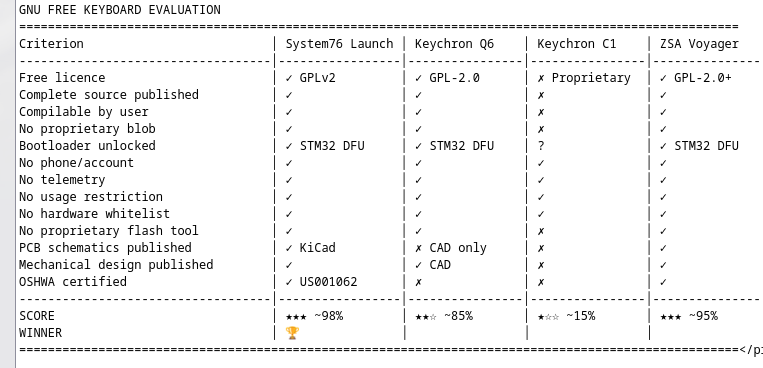
"It turns out that NOT ANY modern mechanical keyboard ... passes the GNU test."
Congratulations, you've successfully debunked a point I never made.
Thank you for your answer.
This is my research, since there is no information, I did what I could, so please do not judge me harshly.

 I am a translator!
Thanks for this. Which link are you referring to? In your results, the first keyboard seems to pass all criteria, then what is missing? I am using a previous version of https://shop.mntre.com/products/mnt-reform-keyboard-40, I don't know how it would be in your comparison.
Hello Avron.
Thank you for your answer and links, I'll check the keyboard and see if it passes whether it eats GNU or not, I'm interested myself )
This is what the keyboard test looks like, the link to which you gave.
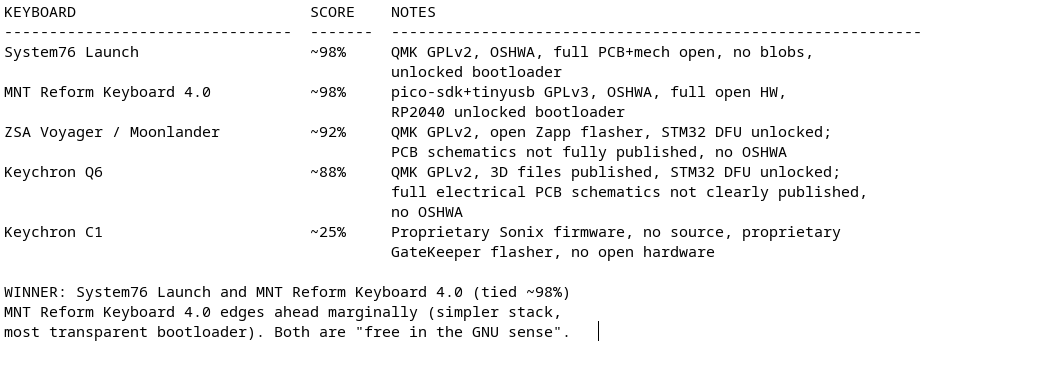

If the most left and most right keyboard ticks all criteria, why not 100%? And what makes the 3% difference between the most left and most right keyboard? Who is "AL"?

I think he means 'AI'. Is quite sad that people feel is easier to talk to a computer than ask the community, but I kind of understand him, people can be harsh, while current AI is super flattering to the point it feels pandering and condescending.

The solution as it usually is, is to go back in time to before evil corpos had the ability to add keyloggers let alone ones with network access.
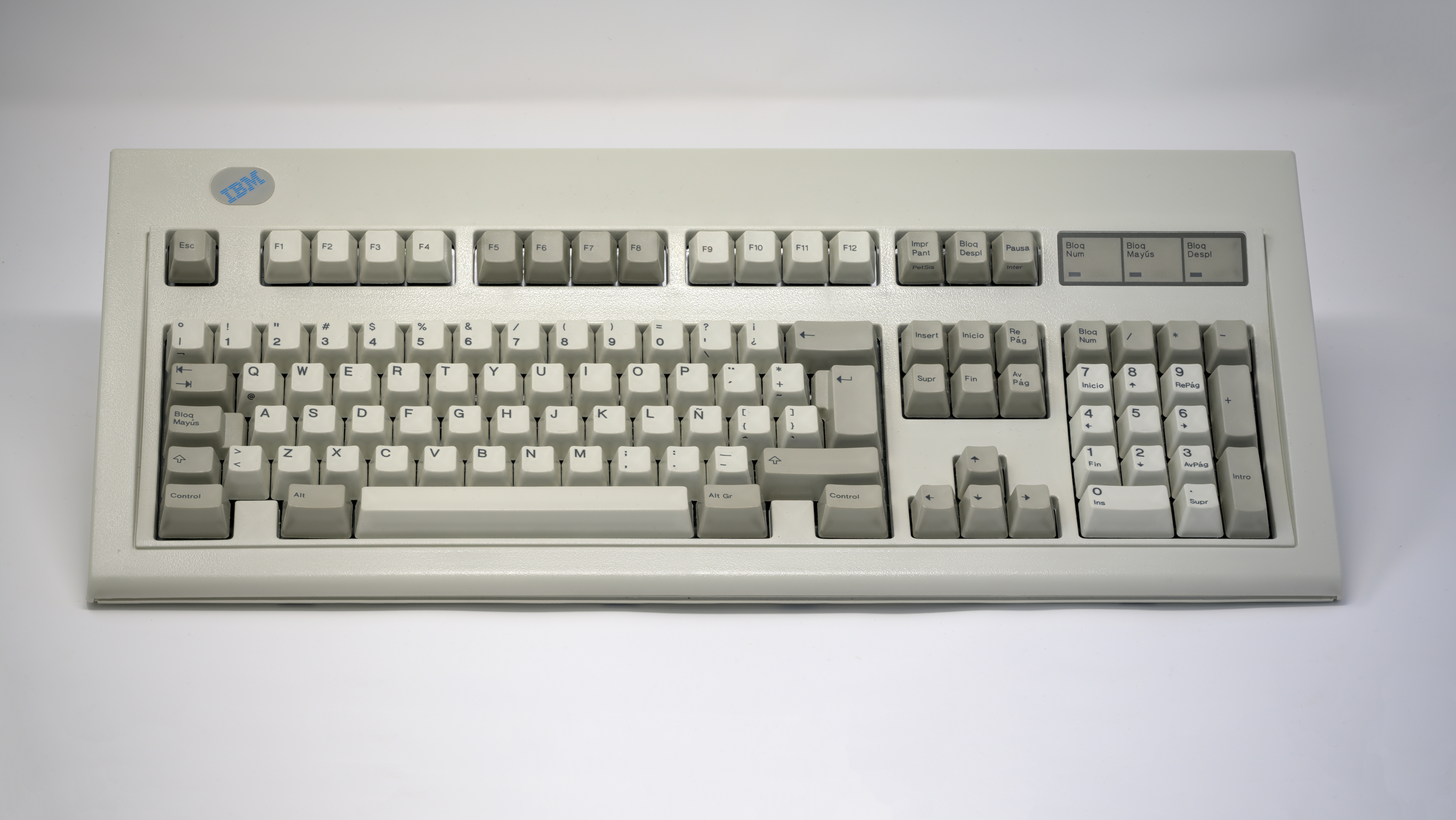
The IBM M1 comes to mind from the 1990s, or its modern equivalent the Unicomp EnduraPro.
Remmember, No software at all is almost always better than Free software is always better than non-free software....

You should message the FSF about this.
«There’s also no explanation about open-source keyboards—if it’s implied that you can use any keyboard and it’s safe for users running Linux Libre, then this section should be created instead of leaving it blank!
Or are users supposed to figure it out on their own or guess?»
If it doesn't run on the CPU, people usually forget about it.
The IBM 029 Card Punch is still the gold standard for keyboards. Key loggers were not possible, but you had to keep an eye on your punchcards. If you have ever used an 029, you will never be satisfied with a chicklet keyboard.
https://www.columbia.edu/cu/computinghistory/029.html

When I read about "mechanical keyboard", I always think about those. No firmware, no microcode, no software.

And also, in the official FSF store I see a "noname" keyboard that is sold for $200 !!!
https://www.thinkpenguin.com/gnu-linux/penguin-keyd-backlit-quiet-mechanical-rgb-compact-keyboard-tpe-pencpkbled
And what conclusion do we have:
Verdict: It's a rebranded generic 61-key mechanical keyboard with a Tux keycap. The "no proprietary drivers" marketing claim only means it works as a standard USB HID device — the firmware itself is closed, the bootloader is locked, and no source code exists. It passes the trivial "no phone-home" boxes but fails all 4 Freedoms at their core. Not free in the GNU sense.

Thinkpenguin is NOT an official FSF store. FSF store doesn't sell any hardware - only stickers/t-shirts/books about free software/etc and it only opens twice a year. Thinkpenguin sell Linux-Libre compatible hardware, but please don't judge FSF or any other people based on the things you see on the Thinkpenguin or any other hardware store :)
And yes, Thinkpenguin sell rebranded hardware. But it's not everything they do: they also have somewhat useful guides, and if I understand correctly, they also helped with creating free firmware for some Atheros WiFi cards. And they seem to do testing for the LibreCMC releases for their routers (TPE-R1*00).
I personally bought a TPE-R1400 router and one of the WiFi cards from them, but I wouldn't buy keyboards or cables, because they're just normal cables and keyboards, there's no GNU sense in them.
Hello Alexander,
In order not to stray away from the main topic, I will just leave links with the FSF domain here
Most of ThinkPenguin's accessories and devices are compatible with fully free hardware setups, no nonfree firmware required!
MOST ???
https://www.fsf.org/givingguide/v16/
Please write which mechanical or magnetic keyboard you use that meets the requirements of the FSF ?

Hi sam-d16, great to see your dedication to finding a keyboard based on a free hardware design;
https://www.gnu.org/philosophy/free-hardware-designs.en.html
Free hardware designs are an important but fairly new area of R&D in the software freedom community. That's because the proprietization of hardware has crept in slowly over decades, gradually eroding the old 'open architecture' approach that allowed x86 "PCs" to become the dominant computing platform. As a result, even people who have spent decades in the Free Code software world may not know as much (yet) about which hardware is made from free designs.
A couple of points on your comments in the this thead.
> the https://h-node.org/hardware/catalogue/en website doesn’t have a separate “Keyboard” section.
I suggest bringing this up with the H-Node community directly, ideally by filing a new issue. This page has information about how to communicate with them;
> Most of ThinkPenguin's accessories and devices are compatible with fully free hardware setups, no nonfree firmware required!
I too would like to know why the word 'most' is there. AFAIK ThinkPenguin are very committed to making sure everything they sell can be used without installing any proprietary software on your computer.
But just to be crystal clear, ThinkPenguin are one of a number of vendors [EDIT: who sell *products* that are] endorsed by the FSF. Getting FSF's Respects Your Freedom certification requires the hardware they sell to work out-of-the-box with Trisquel, and other FSF-endorsed GNU/Linux distros that don't install nonfree firmware or drivers. This may have been what you meant by "official FSF store", but that makes it sounds like the FSF operates the store and makes money from it, which is not the case.
It is my current understanding that no nonfree firmware is going to be loaded by the linux-libre kernel, of which Trisquel uses an equivalent version derived from the Ubuntu version it is based on. Does this not apply to keyboards, mechanical or else?
I have not found any "official FSF store". There seems to be "Respects Your Freedom" products, certified by the FSF, but this does not seem to be intended to endorse every product sold by a single vendor, and that page currently lists six vendors. So either I misunderstood the situation, or some of the above information is inaccurate.
"Companies awarded RYF certification for a given product must not distribute any product-related materials with endorsements or badges to proprietary software, such as "Works with Windows" or "Made for Mac" badges, because these would give an appearance of legitimacy to those proprietary packages, and may make users think the product requires them. However, we don't object to clear factual statements informing the user that the product also works with specific proprietary operating systems."
https://ryf.fsf.org/about/criteria
latenightwake:
> this does not seem to be intended to endorse every product sold by a single vendor
Thanks for this clarification, I've edited my comment accordingly.
now days everything can be a computer, even a keyboard. But an electronic device is not necessarily a computer just because it requires a piece of software inside (the firmware) to function. I really like the following article that I think explains it very well:
https://www.gnu.org/philosophy/free-hardware-designs.en.html in it, unless I misunderstanding, it is explained in said article that if a firmware is not "upgradable" there is not much of an issue to not being able to study it or it being free software.
In my mind, a keyboard with a 'keylogger' it's not harmful unless it can connect to the internet or communicates in any other way, like Bluetooth.
If you buy your keyboard directly from the manufacture, do you think said company could gain something by including a keylogger on it? I would think that it would be risky, because once it is found, no one else would want to do business with them. And why would they do that if the device doesn't have a Bluetooth or wifi? If something like a wireless communication were to be found, again I would think that said company would be singled out.
I see the irony about scandalous recent discoveries expose by a content creator about LG's TVs, but again, those are full-on computers with communications, microphones and even cameras. Those are the real cases we need to point out when it comes to the need of free software.
It is in the name: free SOFTWARE. Non-upgradable non communication firmware can very easily be considered HARDWARE. It can still be used to make harm, but once discover doing so, they can be singled out. But if software can be constantly upgraded there is no end to what it can be made to do (a bomb even).
Could be useful to know the firmware if it could be easily 'upgraded' to benefit from a better performance or functionality, but I don't find it as important as what we need free software for.
I've seen some mouses and keyboard include software to change the device behavior, most of it proprietary. One example I came across is the 'Unify' USB receptors of Logitec, which made it possible to sync different devices to the same USB receptor. The software they offer to do so is not free software, though a free software was reverse engineered. In this seance, I can see the FSF suggesting not to buy them, not because of its firmware but because the software offer to use one of it's main features is proprietary, even if a free solution was developed, just so that the companies understand that proprietary software offerings are unacceptable to us (they are probably trembling right now). So again, the problem is the software offer not the HARDWARE.
I want to say that I'm not against to movements like libre hardware schematics and firmware, which would indeed make it so much easier to develop free drivers for, but for me, they are not as important and necessary as free software and free software drivers which do run in the computer side where the most harm can be done. Also, I can see an intensive to keep some manufacture secrets, which do not really harm the user.